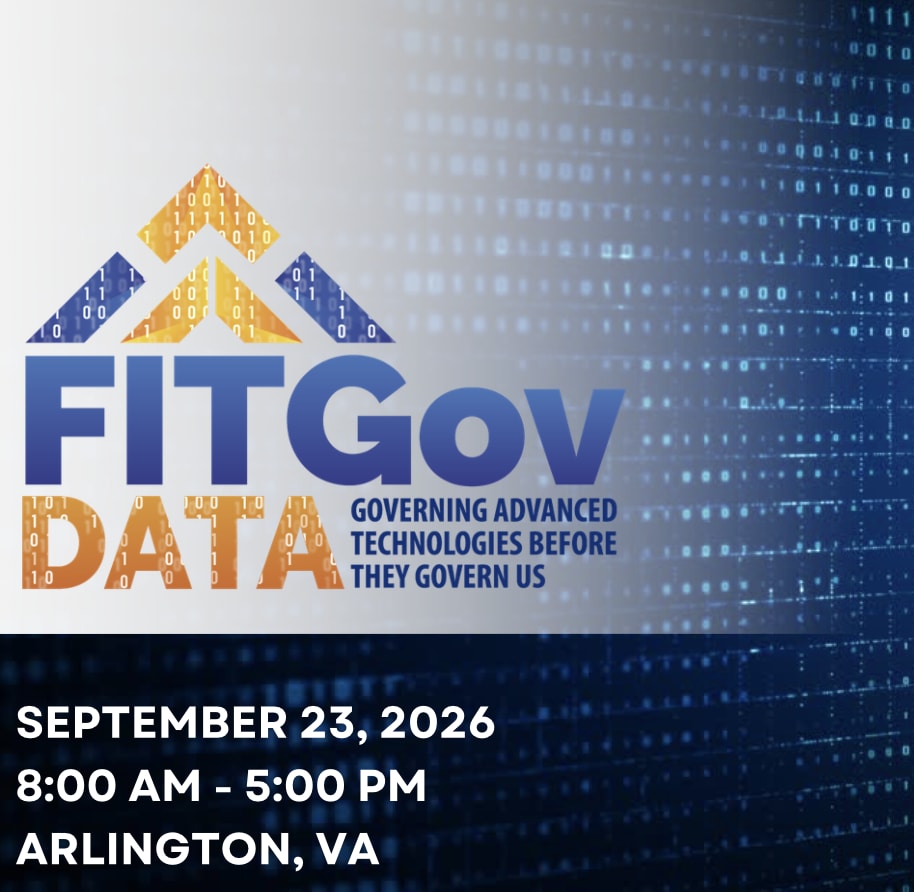
GTSC's FITGovDATA: Accelerating Mission AI & Quantum
Wednesday, September 23, 2026 (8:00 AM - 5:00 PM) (EDT)
Description
Government possesses extraordinary volumes of information, yet much of it remains fragmented across legacy systems, inconsistent standards, multiple ownership structures, security classifications, and aging technology. The challenge is no longer whether agencies will adopt AI and quantum—it is how quickly they can build the trusted, interoperable, and mission-ready data environment required to make these technologies successful. FITGovData will explore all aspects of this: barriers, governance, acquisition, safety, integration and of course, speed.
Agenda:
8:00 – 8:30 AM | Registration, Networking & Breakfast
8:30 – 8:45 AM | Welcome & Opening Remarks
Government has enormous quantities of data, but volume alone does not create mission advantage. Fragmented systems, inconsistent definitions, access restrictions, legacy architectures, unclear ownership, and variable data quality can prevent agencies from applying emerging technologies effectively.
Kristina Tanasichuk, Chief Executive Officer, Government Technology & Services Coalition
Sumeet Luthra, CEO & President, Constellation Inc.
8:45 – 9:15 AM | Opening Keynote
Mike Donnelly, Chief Data Officer, U.S. Immigration and Customs Enforcement
9:15 – 9:45 AM | Breaking the Data Barriers: Why Government Still Struggles to Use the Data It Has
Government data is distributed across legacy platforms, program offices, contractors, security domains, and organizational boundaries. Even when data exists, agencies may lack the authority, infrastructure, standards, or contractual rights necessary to use it. Government and industry leaders will examine the practical obstacles to creating mission-ready data environments and identify where policy, technology, acquisition, and leadership changes can have the greatest impact.
Carin Quiroga, Editorial Board Member, Homeland Security Today; former CDO, ICE; Strategic Core Account Executive, Databricks
John Janek, Chief Technologist, Dev Technology Company
Courtney Winship, former Bureau Chief Data Officer, Diplomatic Technology, U.S. State Department
9:45 – 10:00 AM | Networking Break
10:00 – 10:45 AM | Keynote Panel: AI Is Only as Good as Its Data: Building Trusted Government AI
Government AI systems require more than large datasets. Data must be accurate, representative, current, properly labeled, legally usable, and relevant to the operational environment in which an AI system will perform.
This session will explore how agencies can identify and correct weaknesses before those weaknesses become operational AI failures.
Moderator: Carin Quiroga, Editorial Board Member, Homeland Security Today; former CDO, ICE; Strategic Core Account Executive, Databricks
Beth Puchek, Chief Data Officer, U.S. Consumer Protection Bureau
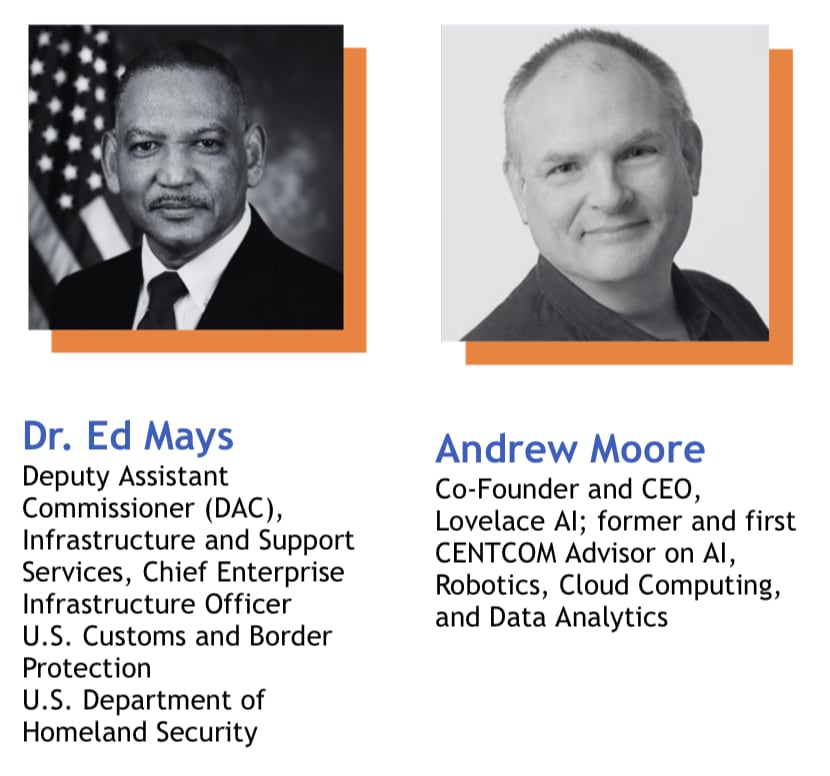
Andrew Moore, Co-Founder and CEO, Lovelace AI; former and first CENTCOM Advisor on AI, Robotics, Cloud Computing, and Data Analytics
Russ James, Chief Architect, COREONYX
Nilanjan Sengupta, Senior Vice President / Industry Market Director, Public Sector and Healthcare, Americas, Thoughtworks
10:45 AM – 11:30 AM | Mission-Ready: The Data Behind Operational AI
Rather than focusing on generalized AI capabilities, this session will examine technologies that solve specific government data problems, including data discovery, preparation, integration, labeling, synthetic data, privacy-enhancing technologies, knowledge graphs, automated metadata, data observability, and secure AI development environments. Central question: Which technologies can materially reduce the time between government data collection and operational mission impact?
Michelle Zebrowski, Chief Data Officer, Office of Information & Technology, U.S. Customs & Border Protection
Dr. Xan Schmickel, Chief Architect, U.S. Customs & Border Protection
Rujuta Wakins, Vice President of Digital Solutions, REI systems
11:30 – 12:30 PM | Networking Lunch
12:30 – 1:30 PM | Operationalizing AI: From Pilot to Mission Performance
Government has no shortage of AI pilots. The challenge is converting experimentation into operational systems that produce measurable improvements in decision-making, efficiency, threat detection, resource allocation, and mission performance.
Moderator: Carin Quiroga, Editorial Board Member, Homeland Security Today; former CDO, ICE; Strategic Core Account Executive, Databricks
Dustin Goetz, Chief Information Officer, Immigration and Customs Enforcement
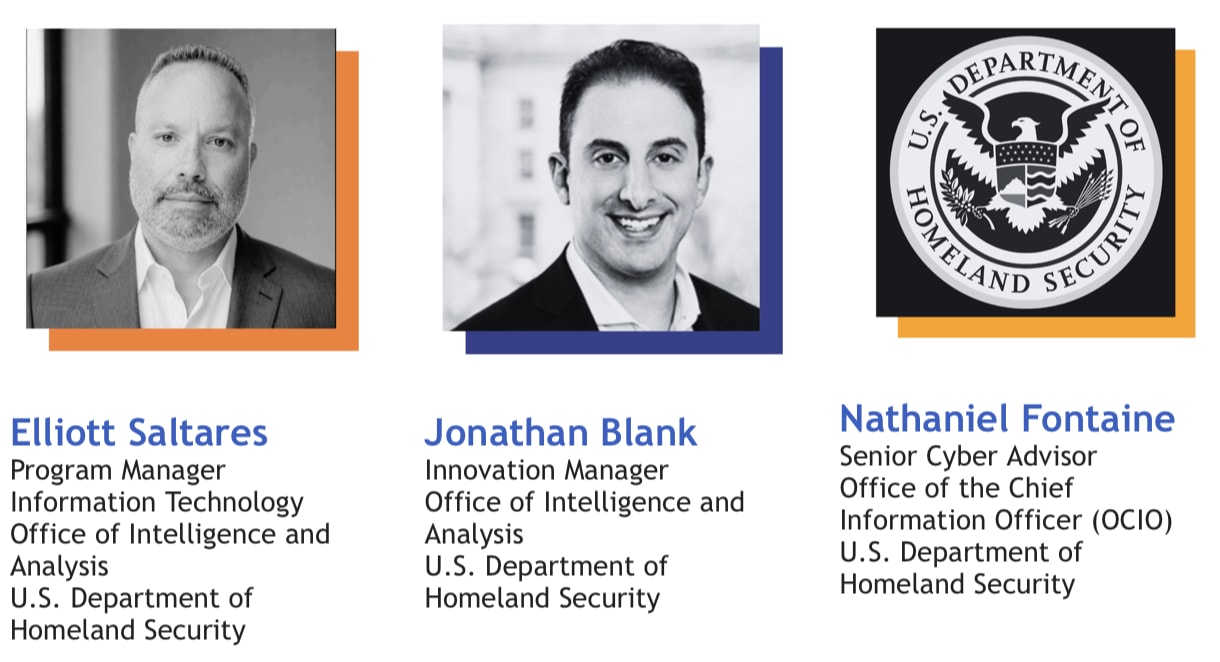
Nate Fontaine, Senior Cyber Advisor, Office of the Chief Information Officer (OCIO), U.S. Department of Homeland Security (DHS)
Jana Eggers, CEO, Nara Logics, an OMNI Company
1:30 – 2:15 PM Prove It: Independent AI Testing, Validation & Continuous Monitoring
Agencies need the ability to independently determine whether an AI system works—not simply rely on developer or vendor claims. This session will examine how government can establish trusted environments for training, validation, testing, red teaming, benchmarking, and continuous monitoring throughout the AI lifecycle.
Elliott Saltares, Information Technology Program Manager, Office of Intelligence & Analysis, U.S. Department of Homeland Security
Jonathan Blank, Innovation Manager, Office of Intelligence & Analysis, U.S. Department of Homeland Security
Brandon Graham, Counter-WMD Operations Expert, Doctoral Researcher, Intelligence and Global Security
Dr. James Giordano, Head, Center for Strategic Deterrence and Weapons of Mass Destruction Studies, Institute for National Strategic Studies, National Defense University; Special Advisor to the Assistant Secretary of Defense (CBRN)
2:15 PM – 3:15 PM | Quantum and AI Literacy: Building the Workforce for What’s Next
Quantum and Artificial Intelligence technologies are advancing rapidly, but preparing for the new era requires more than new hardware and algorithms—it requires a workforce ready to understand, acquire, implement, secure, and support these emerging capabilities. This panel will explore workforce readiness across government and the contractor community, examining the skills agencies will need, how organizations can prepare today, and where government and industry must work together to close emerging talent and knowledge gaps.
Suresh Nair, CEO & President, Ina Solutions
Meikle Paschal, Senior Solutions Architect & Aiuto Practice Lead, Amivero
Kane Gyovai, Chief Technology Officer, BridgePhase
3:15 PM – 4:00 PM | Finding the Quantum Advantage: Which Government Problems Are Actually Ready?
Where could quantum approaches genuinely outperform—or complement—classical computing? Central question: How does government distinguish a real quantum use case from a problem classical computing can solve better?
Moderator: Sumeet Luthra, CEO & President, Constellation Inc.
Dr. Ed Mays, Deputy Assistant Commissioner (DAC), Infrastructure and Support Services, Chief Enterprise Infrastructure Officer U.S. Customs and Border Protection
Esther Han, Deputy Quantum Lead, Deloitte
4:00 – 4:45 PM | Harvest Now, Decrypt Later: Preparing Government Data for the Post-Quantum Era
Quantum readiness is not only about quantum computing. Sensitive government information being protected today may need to remain secure for decades. This session will examine the transition to post-quantum cryptography and the data, system, acquisition, and inventory decisions agencies need to make now.
Ann Dunkin, former CIO, U.S. Department of Energy
Tim Mayers, Chief Cyber Solutions Architect, Delviom
Bob Costello, Chief Digital & Information Officer, Merlin Group; former Chief Information Officer, Cybersecurity and Infrastructure Security Agency
4:45 – 5:15 PM | Closing Keynote
Ha Ngyuen Mcneill, former Acting Administrator, Transportation Security Administration





About Constellation:
Founded in 2006, Constellation Inc. was built on a simple belief: advancing critical national security missions requires exceptional people, innovative thinking, and an unwavering commitment to results. For two decades, we have partnered with U.S. federal agencies to solve complex operational challenges, strengthen mission effectiveness, improve efficiency, and deliver measurable outcomes.
Guided by our commitment to “Excellence Through Innovation,” Constellation serves as a steadfast point of navigation for our clients, providing the clarity, reliability, and expertise needed to advance through evolving mission demands with confidence. As a CMMI Level 3 appraised, ISO 9001:2015, ISO 20000-1:2018, and ISO 27001:2022 certified Small Business and federal prime contractor, we support defense, homeland security, civilian, and national security missions. Our capabilities span acquisition and program management, data analytics, automation, emerging technologies, and mission support - helping agencies modernize operations, make better-informed decisions, and achieve lasting mission impact.
About BridgePhase:
BridgePhase is a technology and engineering company helping federal agencies modernize mission systems, accelerate software delivery, and responsibly apply emerging technologies to complex operational challenges. We support federal missions across the homeland security and national defense communities, combining deep mission understanding with expertise in artificial intelligence and data, cloud-native application development, DevSecOps, platform engineering, cybersecurity, and digital modernization.
Our teams build and operate secure, scalable technology in some of government’s most demanding environments, from modernizing large-scale mission applications and engineering enterprise cloud platforms to helping agencies establish the data, governance, and technical foundations needed to put AI into practice. We focus on moving beyond experimentation to deliver capabilities that can be integrated, secured, tested, and operationalized within real mission environments.
Through BridgePhase Labs, we extend that work by developing and applying emerging capabilities in AI, intelligent automation, data analytics, and next-generation software engineering. Labs provides an environment to rapidly prototype new approaches, validate them against practical government use cases, and translate promising technologies into mission-ready solutions. This allows us to connect emerging technology with the engineering discipline required to move promising ideas into operational use.
Learn more at bridgephase.com or contact us at info@bridgephase.com.
4121 Wilson Blvd Suite 200
Arlington, VA United States